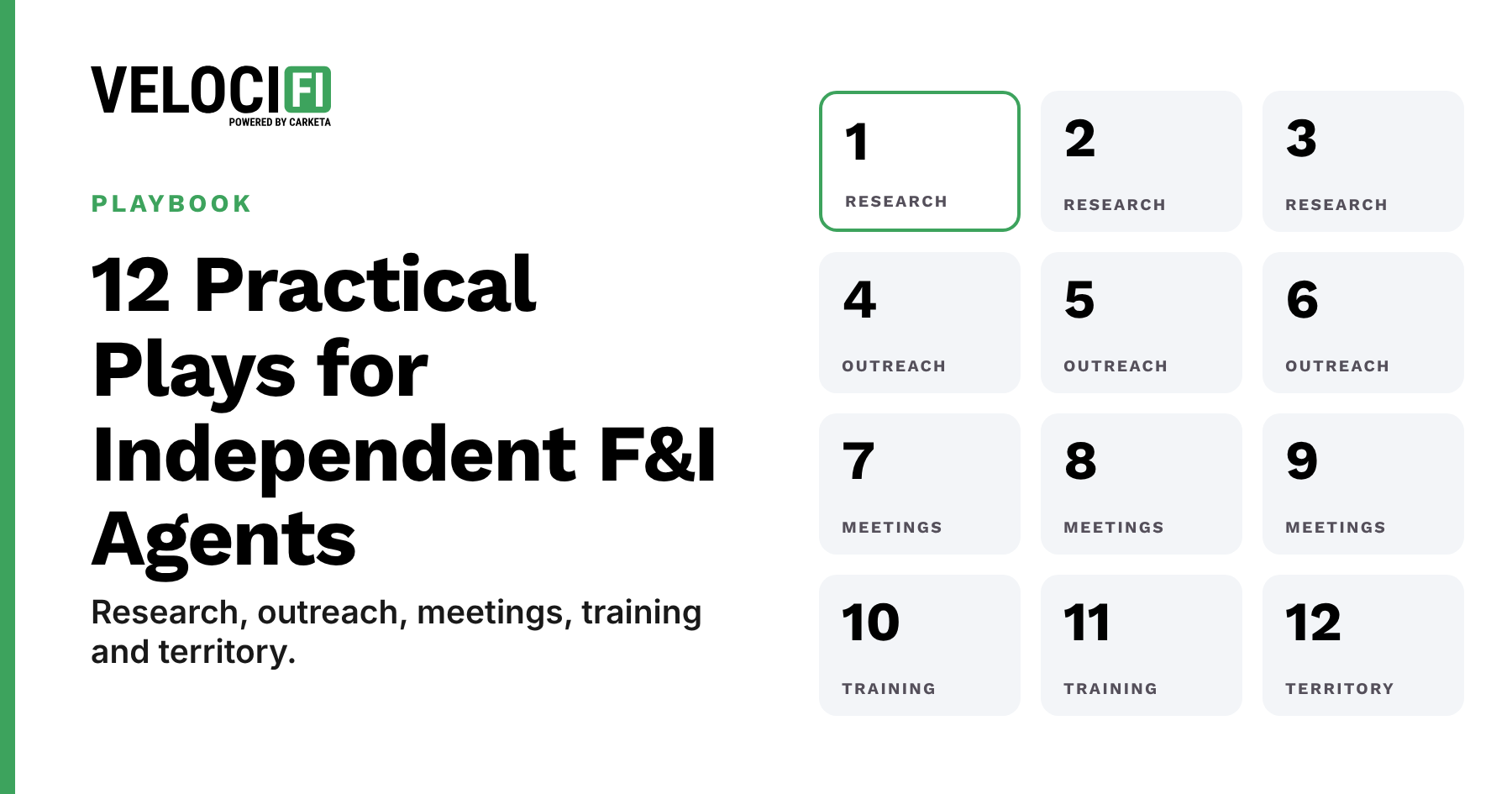
Independent F&I agents can run twelve plays each week: build a short brief on each dealer, rank prospects, personalize outreach, follow up after visits, prepare meeting agendas, practice objections, create quick-reference sheets for finance managers and review territory results. Each play makes your next conversation with a dealer more specific.
Dealers buy from agents they trust, and trust gets built in person. These twelve plays cover the hours around those conversations: research, outreach, prep, follow-up and training. Run a few of them each week and you’ll walk into more meetings knowing something about the store.
They’re grouped by where they fit in your week. If you use a writing assistant, it can speed up the first draft of several of them. Check every fact before anything goes out.
Prospecting and research
1. Build a five-minute dealer brief
Pull together public information (the dealer’s website, inventory page, reviews and your own notes) and write a one-page brief. Cover the store type, apparent volume, inventory mix, financing messages, recent news and three questions to ask the F&I director.
2. Read the inventory for product fit
Look at the inventory before you call. Note the average age, mileage ranges, makes and EV share. High-mileage inventory leads to a different product conversation than late-model certified units.
3. Rank your prospect list with your own criteria
Export your list from VelociFI, then sort it by your criteria: volume band, distance, dealer type and current status. Group the dealers into tiers and write one line on why each top-tier dealer made the cut. You make the final call, but you start with a ranked list.
Outreach
4. Personalize first-touch emails
Write one strong email yourself. Then change the opening line for each dealer using what you found in Play 1. Keep it short and specific, and delete anything generic.
5. Plan a three-touch follow-up
After a first visit, send a recap email, then something useful for that store, such as an article or a data point, then a check-in. Write each one in your own voice.
6. Prepare for the gatekeeper
Write a short, honest explanation of why you’re calling that gets you to the right person, whether that’s the GM, the F&I director or the owner. Practice it out loud until it sounds like you.
Meetings and follow-through
7. Build a meeting agenda from your notes
Turn your notes into a one-page agenda. List their goals, what you heard last time, what you’ll show and the decision you’re asking for.
8. Turn every visit into next steps
After each visit, write down action items, owners and dates while it’s fresh. Put them in your CRM or your VelociFI notes so nothing gets lost.
9. Rehearse the objections
Have a colleague play a skeptical dealer principal. “We’re happy with our current provider.” “We already have a menu that works.” “Our F&I guy won’t use a new menu.” Practice your answers until they sound natural.
Training and dealer support
10. Make quick-reference sheets
Take the provider’s approved product materials and boil them down to a one-page sheet for finance managers. Cover what’s covered, what isn’t and the key eligibility rules. Check every line against the contract, because accuracy matters more than speed here.
11. Run a ten-minute training refresher
Pick one topic, such as presenting the full menu every time or handling a “no” respectfully, and outline a ten-minute session. Add real examples from the dealer’s own deals. Have the dealer’s compliance lead or counsel review any compliance content before you use it.
Territory planning
12. Review your territory for patterns
Export your dealer list from VelociFI and review it alongside your own visit notes for patterns. Which dealer types convert? How many touches does it usually take? Where are you spending drive time with nothing to show for it? Treat what you find as a theory to test.
A sample weekly routine
| When | Plays | What it covers |
|---|---|---|
| Monday | Rank this week’s prospects (Play 3) and build briefs for planned visits (Play 1) | Research before each call |
| Tuesday to Thursday | Personalize outreach (Play 4), write agendas before visits (Play 7) and next steps after (Play 8) | Prep and notes |
| Friday | Plan follow-ups (Play 5) and review territory patterns (Play 12) | Follow-up and planning |
Get the weekly checklist
Want this routine on one page? Download the weekly checklist for independent F&I agents and keep it next to your planner.
Keep it honest
- Verify every fact. If you can’t confirm a statistic or a product detail, don’t send it. That goes double for anything a writing assistant drafted.
- Use approved product language. Product descriptions have to match the contract. Use the provider’s wording.
- Get compliance content reviewed. Anything about disclosures, licensing or regulations should go to the dealer’s compliance lead or counsel.
- Keep it human. Dealers can tell when an email was written on autopilot. Make it sound like you.
Where to start
Pick two plays this week. Play 1 (the dealer brief) and Play 8 (visit follow-up) are easy to start with. Run them for a month, then add more. Good input data improves every play. VelociFI gives F&I agents and TPAs dealer data on more than 60,000 dealerships, territory mapping, and notes and lists in one place.
Frequently Asked Questions
Rank your prospects, research the dealers you plan to visit, personalize your outreach, hold your meetings, and write up next steps the same day. End the week by following up and reviewing your territory for patterns.
Build a one-page brief on the store covering its type, apparent volume, inventory mix, financing messages and recent news. Write three questions for the F&I director and a short agenda that ends with the decision you’re asking for.
Write down action items, owners and dates the same day. Send a short recap, then follow with something useful for that store, such as an article or data point, and a check-in.
Start with a pre-call dealer brief and a same-day follow-up after each visit. Both are quick, easy to check for accuracy and make your next conversation with the dealer more specific.
Better plays start with better dealer data. Get a Demo to see dealer data, territory maps and notes in one place.